Reading Casino Stats and Payout Tables Like a Pro
In the world of online and land-based casinos, numbers matter far more than most players realize. Behind the flashing lights and exciting sounds, every game runs on mathematics: return-to-player percentages, volatility levels, and payout tables that determine exactly how much you can win. Unfortunately, many players overlook these details, relying only on luck or instinct. The result is predictable—missed opportunities and faster losses.
But when you learn how to read casino stats and payout tables like a professional, you turn raw data into a weapon. You begin to see patterns, spot fair games, and choose wisely where to risk your money. This guide will teach you exactly how to do that, with clear explanations, practical examples, and long-term strategies to keep you in control.
Why Casino Stats Are Essential
Casinos are built to profit in the long run, but not all games are equal. Understanding the underlying stats allows you to:
- Identify better odds. Games like blackjack or video poker often offer higher returns than slots.
- Avoid traps. Some flashy games look appealing but hide very low return-to-player (RTP) rates.
- Manage expectations. Stats tell you whether a game offers frequent small wins or rare but massive payouts.
Imagine two slot machines standing side by side: one has an RTP of 92%, another 98%. At first glance, that 6% difference seems minor. Over time, though, it determines whether you leave with a decent bankroll or walk away empty-handed.
Understanding RTP (Return to Player)
Return to Player, or RTP, is the most basic statistic every gambler should know. It represents the percentage of wagered money a game will return to players over the long run.
For example, a slot with 96% RTP means that for every $100 wagered, $96 will theoretically return to players and $4 will remain with the casino. But it’s crucial to remember this is calculated across thousands or even millions of spins—not a single session.
Let’s illustrate:
- Slot A: 95% RTP → average loss of $5 per $100 wagered.
- Slot B: 99% RTP → average loss of $1 per $100 wagered.
The difference compounds heavily over months of play. Choosing higher RTP games is one of the simplest ways to improve your long-term results.
The Role of Volatility
While RTP tells you how much a game pays back, volatility explains how it pays back.
- Low volatility games deliver small, frequent wins. Great for casual players and those who want longer play sessions.
- Medium volatility games balance risk and reward. You’ll see a mix of steady returns and occasional bigger payouts.
- High volatility games may keep you waiting through dozens of losing spins before suddenly paying out a huge jackpot.
For example, a low-volatility slot might pay you back $5 for every $10 lost, keeping you entertained for hours. A high-volatility slot could drain $50 quickly but then return $200 in one lucky spin. The right choice depends on your bankroll size and personal risk tolerance.
Decoding Payout Tables
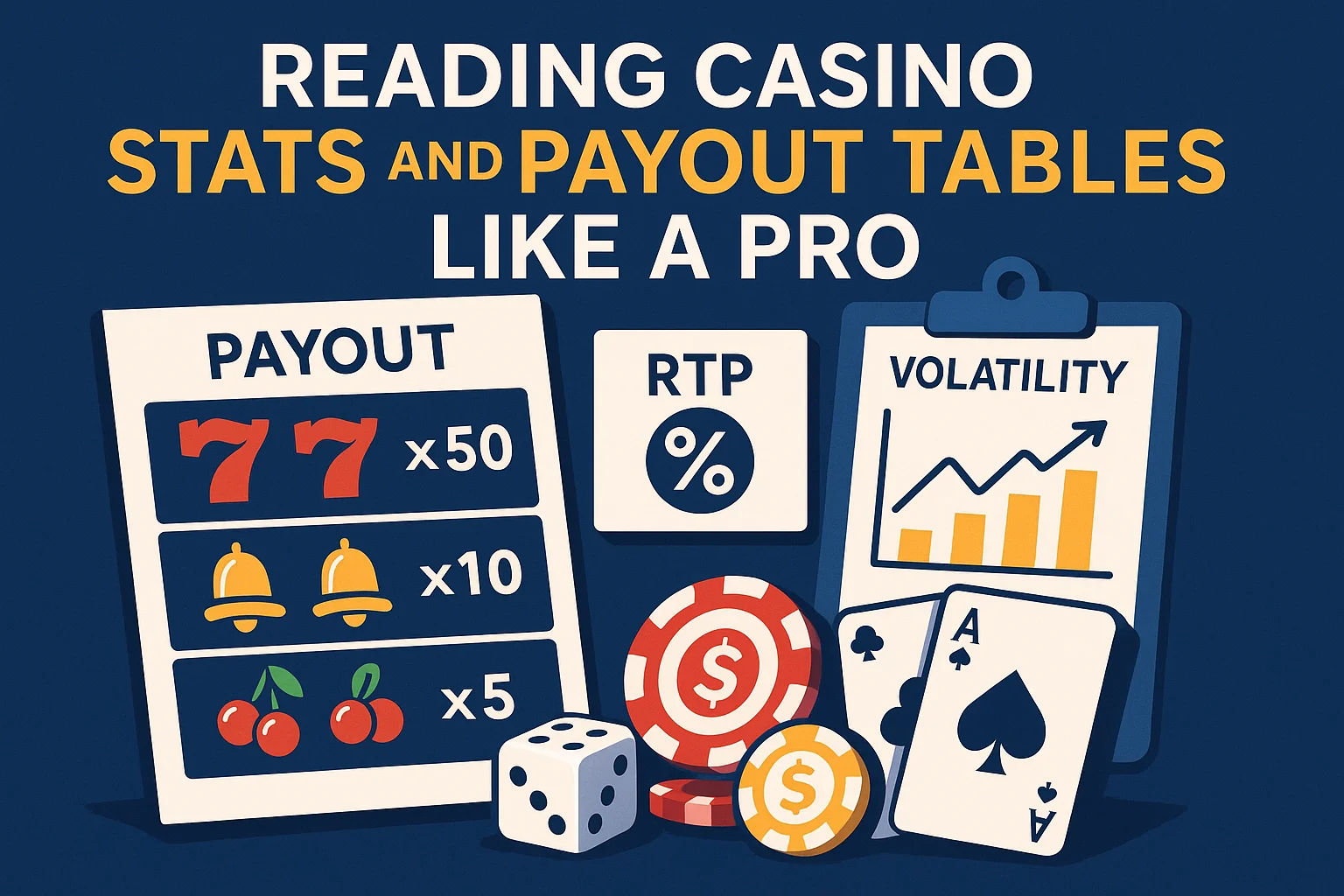
The payout table—often called the “paytable”—is the instruction manual for any casino game. It shows what each symbol, combination, or hand is worth and explains bonus features.
In slot machines, a paytable might reveal:
- Three cherries = 2x your bet.
- Three bars = 10x your bet.
- Three sevens = 100x your bet.
But skilled players look beyond the obvious:
- High vs. low-value symbols. Which ones appear often, and which pay massive sums but rarely land?
- Wilds and scatters. These often unlock free spins or multipliers that account for the bulk of real winnings.
- Number of paylines. Some slots use fixed paylines, others let you choose. More lines increase your odds of hitting something but also raise the cost per spin.
In table games, payout tables matter just as much. In video poker, for example, the difference between a “9/6 Jacks or Better” paytable and an “8/5” version reduces the RTP by several percentage points. To a casual player, they look the same—but the smart gambler knows which one is worth their money.
Common Mistakes Players Make with Stats
Most casino players fail not because they lack luck, but because they ignore the math. The most common mistakes include:
- Ignoring RTP entirely and choosing games based only on graphics.
- Confusing volatility with RTP, assuming high volatility equals poor returns.
- Skipping paytables, missing crucial information about special features.
- Believing in “hot” and “cold” streaks, when in reality every spin is independent.
These errors keep casinos profitable. Professionals avoid them by reading stats first and playing second.
Practical Strategies for Reading Stats Like a Pro
- Check the RTP before you play. Most providers disclose it openly—if not, search their website or reviews.
- Compare different versions of the same game. Some casinos quietly offer reduced-RTP versions.
- Test games in demo mode. This lets you explore paytables and bonus mechanics without risk.
- Track your own results. Keep a gambling journal to compare real experiences with expected outcomes.
- Choose volatility based on your bankroll. Smaller budgets favor low-to-medium volatility games; big risk-takers may prefer high volatility.
Case Study: Blackjack vs. Slots
Let’s compare two players with identical budgets:
- Player A chooses a slot with 92% RTP and bets $5 per spin for 100 spins. Expected loss: about $40.
- Player B chooses blackjack with 99.5% RTP and bets the same $5 per hand for 100 hands. Expected loss: only $2.50.
While blackjack requires strategy and discipline, the statistical advantage is undeniable. The numbers don’t lie.
The Psychological Side of Stats
There’s also a psychological benefit to reading stats. Many players fall into the trap of thinking “I’m due for a win” after several losses, or that a slot “owes” them a payout. This is gambler’s fallacy, and it ruins bankrolls.
When you rely on stats instead of emotion, you keep expectations realistic. You no longer see the casino as a magical source of luck but as a numbers game where informed choices stretch your entertainment time and reduce losses.
Conclusion
Reading casino stats and payout tables like a pro isn’t about memorizing complex formulas. It’s about respecting the numbers, understanding what they mean, and using them to guide your decisions. RTP tells you how generous a game is. Volatility shows how winnings are distributed. Paytables reveal the rules that make the difference between steady play and sudden jackpots.
The best players aren’t those who always win—they’re those who know when the odds are worth the risk and when they’re not. By learning to read casino stats, you transform gambling from blind chance into an informed form of entertainment.